
This post is the second in a series of articles discussing the Vocal Folds and their role they play when singing. In this article, I will introduce the concepts of compression and decompression, and how helpful they can be to our sound.
Note: If you haven’t already, check out Part 1 of this series first.
Component 2: Compression
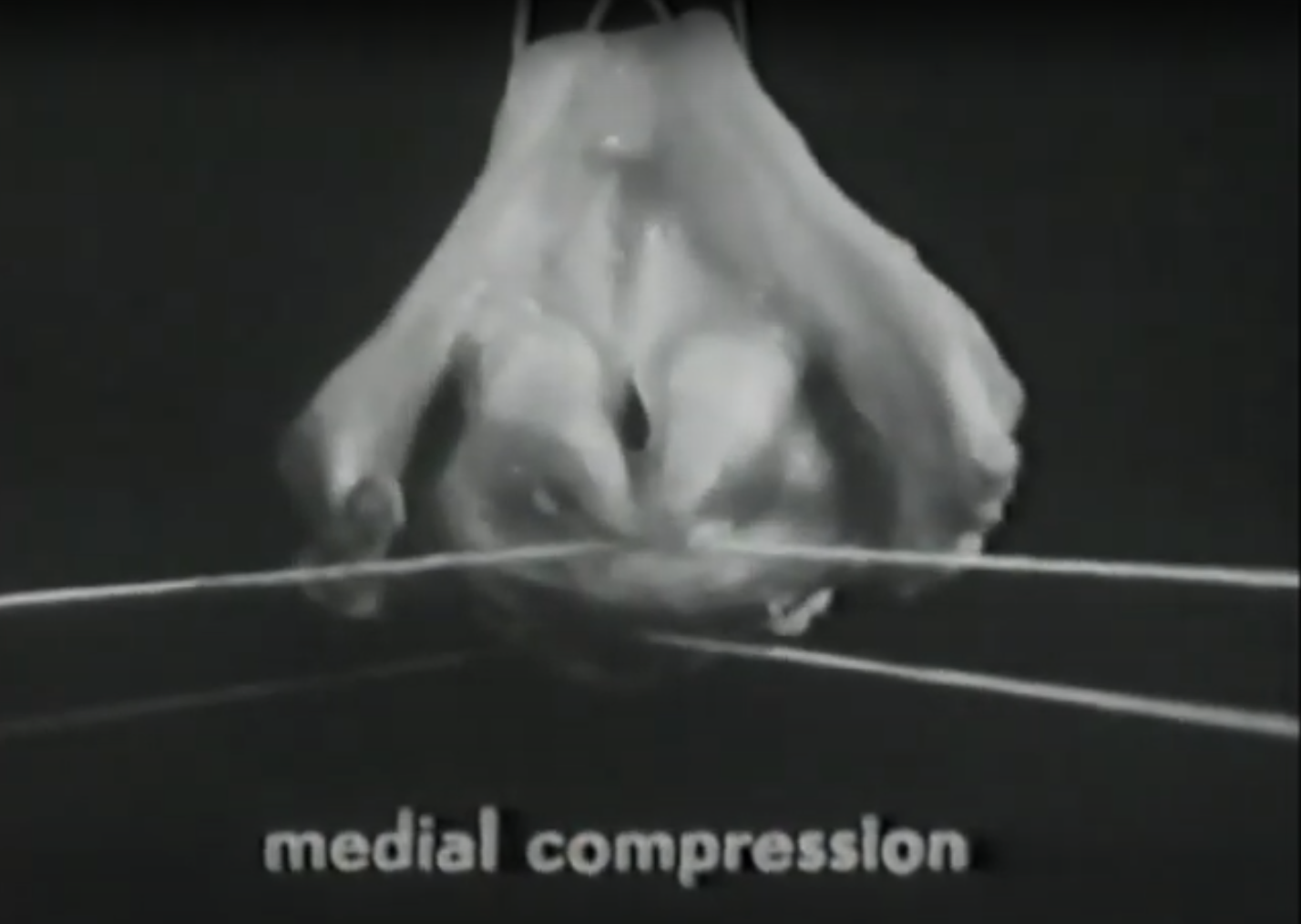
Compression, or medial compression, is how closely the vocal folds are brought together medially.
In very practical terms, it just means how breathy or pressed/squeezed your sound is.
Let’s have a look at the Vibrating Larynx to understand how this works, and then get some practical tips on how to use compression and decompression.
Practical Structure of the Larynx (For Compression)
The Relevant Parts

From Screenshot 1, we can see what the larynx and vocal folds look like from above. This is the neutral starting point of the larynx as seen at 14:16 of the Vibrating Larynx.
The blue lines are the vocal folds themselves. They attach to the arytenoids in the back, which I have labelled with orange lines.
The open space in the middle is known as the glottis.
For reference, I have also labeled the thyroid notch in the front so that you can relate the picture back to your own body.
When the vocal folds move towards the midline (labeled in pink), we call this adduction. This is also known as “medial compression”, because the folds are brought towards the middle. For simplicity, we will call this “compression”.
If the vocal folds move away from the midline, we call this “abduction”. We will also call this “decompression”.
The Larynx During Decompression

When you breathe in and out (without making any sound), the glottis is completely open. In other words, the vocal folds are completely abducted or decompressed. The glottis is also open.
Decompression takes place when the posterior cricoarytenoid (PCA) muscles contract. When this takes place, the front portions of the arytenoids swivel away from the midline. In turn, this action moves the vocal folds away from the midline (see Screenshot 2).
The Larynx During Compression
When you use your vocal folds to create a pitch (this is also known as “phonating”), your vocal folds must be close enough to vibrate the air passing through it. Note that they do not need to touch each other.
In order to bring the vocal folds close together, two muscles are involved.

First, the lateral cricoarytenoid (LCA) muscles contract, which swivels the front part of the arytenoids towards each other. This results in the vocal folds adducting. However, the glottis is not completely closed when the LCA muscles work alone.
In this case, if you tried to phonate (make a pitch), there would be some breath noise leaking through the hole in the back of the vocal folds. Practically, you will sound more “breathy”.

To close the glottis completely, the interarytenoid muscles (IA) must also contract. This swivels the back part of the arytenoids closer together, which closes off the glottis.
In this case, if you tried to phonate, there would be little to no breath noise leaking through. You might call the resulting sound a “clean” sound. If the adduction is very tight, you might even call the resulting sound “pressed” or “strained”.
Degrees of Compression
As you might have guessed, there are varying degrees of compression. Starting from least compressed to most compressed:
- Silent Breathing – When you breathe silently, your vocal folds are so decompressed that they do not make any sound.
- “H” , Voiceless Whispers and Sighs – When you make an “H” sound, whisper, or sigh without producing any pitch, your glottis closes more than when you breathe silently, but is still so decompressed that there is no pitch.
- Breathy Phonation / Aspirate Phonation / “Decompression”, Pitched Sighs – When your vocal folds are close enough to make a pitch but air leaks through, this is known as breathy (or “aspirate”) phonation. This might happen if your vocal folds are not completely adducted or if air is leaking through the back of the vocal folds. This is usually what we’re talking about when we refer to “decompressed” singing.
- Flow Phonation / “Balanced Compression” – When there is little to no air leakage in then sound, and your vocal folds are not pressed together too tightly, we call this flow phonation or balanced compression.
- Pressed Phonation / “Overcompression” – When the vocal folds are pressed together very tightly, we call this pressed phonation or overcompression. The final sound will usually come off as “strained” or “pushed”.
- Vocal Fry – We will go through this in the next part, but vocal fry (or pulse / creak register) also achieves a high amount of compression, but does not necessarily sound “strained” or “pushed”.
- Glottal Stop, Valsalva Maneuver – When you lift heavy objects or go to the bathroom, your vocal folds might close together so tightly that they stop phonating altogether. This can also take place if you try to make a “B” sound but don’t open your mouth to a vowel (similar results can be achieved with “D” or “G”). You might also intentionally close your vocal folds this tightly when you use a “glottal stop”, such as the beginning of words starting with a vowel like “apple” or “orange”.
Why bother with compression and decompression?
Compression and decompression are equally important. Some singers might need one more than the other though.
Decompression
If you want to sing using a breathy phonation, you will definitely need to use decompression. Maybe you’re singing a sad song, or you’re trying to sing in a way that’s more delicate, vulnerable, or even sensual. Here, decompression can be an artistic choice.
But what if you don’t want to sing breathy? What if you’d rather sing in a balanced manner or if you want to sing something powerful?
In such a case, you will still need to learn how to decompress for a more technical reason: You have to know how to avoid overdoing it. If you squeeze your vocal folds too tightly, your sound will start sounding strained and, even worse, feeling strained.
Knowing how to decompress (or go fully breathy) will help you move from an overcompressed or strained sound to a more balanced sound.
Effect of Decompression on the Final Sound
For those who read our previous article on the “Why does your voice sound the way it does?“, more decompressed phonation produces a steeper spectral slope, and will therefore sound darker (more like “oo” in “boot” or “o” in “boat”). In addition, breathy phonation will also add breath noise to the signal.
Decompression also tends to keep us in a higher laryngeal register, which will be discussed in the next article.
Compression
Again, you can use compression as an artistic choice. You can try singing more powerful or loud songs with more compression (though you will have to avoid overdoing it, as mentioned above).
As a technical matter, if you always sing too softly or too breathily, adding compression will be the quickest fix.
Effect of breath pressure on compression
In most cases, additional breath pressure will cause your vocal folds to compress more to
Effect of Compression on the Final Sound
For those who read our previous article, “Why does your voice sound the way it does?“, more compressed phonation produces a gentler spectral slope, and will therefore sound brighter (more like “a” in “bat or “ee” in “bee”).
A more compressed sound will also generally sound louder than a more decompressed one. As a caveat, at the extremes, such as vocal fry and the glottal stop, your sound could get softer or your phonation could stop all together.
Compression also tends to keep us in a lower laryngeal register, which will be discussed in the next article.
How do I sing with a more compressed or decompressed sound?
Singing will usually involve toeing the line between being too breathy and being too pressed.
In order to move the needle one way or the other, the easiest way is to use the most extreme version of the sound we want.
For example, if your singing is too tight or strained, you can start with the “h” sound and slowly introduce pitch. This will invite a more breathy phonation. It is important not to try to override the “h” by forcing a lot of air.
If instead you want to strengthen your voice, you can use vocal fry, glottal stops, or “b”/”d”/”g” sounds to induce a more compressed sound in your voice.
There are many other exercises we can do, but they would be too numerous to list in this one article.
Final Thoughts on Compression
Sometimes, we hear singers or teachers saying “Don’t sing from the throat”.
If they’re saying we should ignore all the sensations in our neck, this couldn’t be further from the truth.
The most direct way to address strain or weakness in the voice is to go directly to the source: the vocal folds themselves.
As we will learn in the next article in this series, the compression of the vocal folds is also a key factor when it comes to one of the most important, if not the most important, concepts in singing: registration.
Leave a Reply